About me

Sunday, 17 September 2023

It's not hard to speak out; it's only hard to be the first person to do so

'I used to think if I wanted to get somewhere I had to impress the right people. Then I realised that if you impress enough of the wrong ones you can do whatever you want anyway.' Grace Petrie

'No one is too small to make a difference' Greta Thunberg


It's very hard to speak out in the face of injustice. Racism, sexism, homophobia, transphobia and so on still doggedly pursue us on our journey through this life, and I think it's important to sometimes take a moment to acknowledge to ourselves how enormously difficult this kind of this is to speak out against.

Acknowledging it means putting our thought processes down on paper (or on a screen) so here goes:


1) I feel bad for that person that's being oppressed.

2) But maybe the oppressor has something of a point? Let's listen to both sides.

3) Okay, yeah, I don't really agree with what that person's saying.

4) But hold on, aren't I in favour of free speech?

5) Maybe that person just knows more than I do?

6) Maybe I should just stay out of it.

7) No, I can't do that. That's not fair.

8) But the thing is, I don't want to draw attention to myself.

9) No one else is saying anything.

10) God, I have so much to do today.

11) I don't really have the energy.

12) I'll give that person a hug when everyone else has gone. That will at least help them emotionally.


Points 9 and 10 are the most crucial in understanding the psychological phenomenon behind it. The urge to conform is a highly powerful one within society (I used to study psychology, and this was the first part of it I was ever taught about - it hooked me right from the start), and in addition to that, most human beings are loaded with too many priorities in life to really have time to look at the wrongs in the world - the wrongs that in fact, they themselves may be propping up.

I work in the entertainment world, and things there are immensely weighted in favour of the powerful (which is why there's such a high instance of popular entertainers being accused of things like sexual assault - another one came out yesterday, and perhaps it will be the subject of a different blog, I don't know yet). Nowadays, there's a lot of talk about higher representation of things like people of colour, the disabled, LGBTQ+ people and so on - but from what I've seen, a lot of this is just for show. I wrote a bit about my experiences of this being just for show in this blog that I wrote back in January, but it also backs up my overall point about conformity. There is more talk about it nowadays, therefore in some respects it's easier to call out - but in other respects it isn't. It's only easy to call out if your view is in line exactly with what everyone else is saying. If it contradicts the dominant narrative, it's quite hard to get up on your pedestal and call it out, as I found with my objection to the notion that only LGBTQ+ actors can play LGBTQ+ parts. I argued that this is actually harmful to LGBTQ+ rights, and I was quite taken aback by the levels of hostility I got for expressing this viewpoint - even though it's an injustice I've experienced myself as an LGBTQ+ performer.

The entertainment world is where I witness most of this stuff first-hand because that is where I work - however, it's something that applies to the whole of society generally. Particularly in relation to the Labour Party at the moment, what I see of what they're doing, what with ruling out wealth taxes, ditching promises to axe tuition fees and expelling numerous members for calling anything out, is an attempt to reduce the level of opinion that it's acceptable to express. This kind of thing, unfortunately, works. There are so many examples throughout history of it working. When none of the leading political figures are willing to say anything remotely radical, it becomes very hard for any regular person to say or do anything radical as well. If they do, they're likely to be either mocked or get into trouble - and they know that as well, and the fear of losing social legitimacy is often a very strong deterrent.

But, I won't be entirely scathing about conformity either. Like every human function, I do believe that it has its place and can be used for good rather than harm. It's not hard to speak against injustice; it's only hard if you feel that no one's on your side. Once the first person has done it, it's so easy for others to get caught up in it. I can see no better example of this than Greta Thunberg, who never expected her small one-person protest outside the Swedish Parliament to catch on as much as it did. Human beings have a tendency to create a snowball effect with one another, and this can be a good thing as well as a bad thing. What I would advise though is that we always think rationally about what we're doing - whether it really helps, or whether we're just jumping on the bandwagon. Many, many times it does help, and climate activism is an area where I believe it is helping - however, this is also how people join cults.

Dialogue is always the cure for this dilemma. If we're open to talking to one another, even if some of us are expressing opinions that we really don't agree with, we can make so much progress. I have some friends who have some views that I really don't agree with - but I always think, there's a reason they think that, and that reason is probably somewhat legitimate. I think even people who hold racist views, if you really probe into why they think that, eventually just come back to feeling oppressed within society themselves. And they're allowed to feel like that, because most of us are oppressed in some way; and part of the nature of oppression involves turning people against one another. This removes their only weapon; the ability to talk, engage and collectively fight back. There are so many more oppressed than there are oppressors; we could come together and change the system in a single day, if we decided to.

What doesn't work is toeing the line in the hope that eventually you'll be in a higher-up position in which to change things. No one is EVER allowed to change things by the political class. Change only comes from lower down. I won't ever criticise someone who compromises their principles in order to get by, because in this world it is very hard to get by and we all do what we can - but I will say that it doesn't really work. All that tends to achieve is a headache. If you're someone who isn't sure what they can do to help deal with the problem they're most concerned about, I'd advise just chatting to your friends about it. There's so much of a culture of 'let's not bring politics into things', but what if there wasn't? What if we could talk to our friends about things going on in the world that were worrying us? When we can do that, even if we can't immediately come up with a solution, it just feels like there's a weight off our shoulders. I'm witnessing this myself quite a lot at the moment in relation to the day centre in Abergavenny my partner is fighting to save. We've harnessed the strong feelings of so many people, people who perhaps felt it was a losing battle before we started talking about it, and there's such a feeling of hope and optimism amongst the group now. It's a feeling of strength. This is what the oppressors most fear.

I started this with a quote from Grace Petrie, who is one of my absolute favourite protest singers. She said this at a concert I saw her in last year, before singing a song called 'We've Got An Office In Hackney'. It's essentially about being a protest singer getting a bit more attention, and whether that would compromise one's principles. Have a listen - it's a lovely song:


My Facebook My Twitter

Sunday, 3 September 2023

Tips to balance good activism with bad mental health

I'll be frank, my mental health has been pretty poor lately.

I've had two bereavements this year, some quite stressful work to do, intense disagreements with people, just low energy generally... and awful things happening in the world. I sometimes think that the cruellest thing is that the more you care about changing the world, the more fatigued it makes you feel. This is the reason why many activists experience such burnout. It's often said that you lose your idealism as you age, and there's some truth in that statement. Most of us start off with the motivation that we're going to sort the world out quite quickly, and then if it doesn't quite happen like that it can be quite demotivating. I found after the 2019 General Election in particular, the huge numbers of people who were keen to achieve decent socialism in the UK kind of disappeared (although I think they are still out there, and can still be reached).

I've been having these problems for years, and I've written a bit about them on previous blogs. Unlike other occasions when things have been difficult for me though, I have actually been making more effort to keep my blog updated this time. This is one way that I've been coping... a lot of the time in the past I've gone through long periods of failing to bother updating this, and then that spirals. The more time passes, the more I have to write about, and then I don't know what to write first. Continuing to make myself write has had the benefit that I look out for interesting things to write about and create new perspectives on them... which is beneficial for my state of mind as much as anything else.

So that would be my first tip for staying sane in a world that seems like it's against you - to give something to focus on on a regular basis. It's not always easy to motivate yourself, but you feel so much better after you've done it. My second tip would be to find a specific project to work on. There's a theory that the only thing you need to improve the world is to improve someone's world, and I really relate to that. As regular readers will know, I'm actively involved in a campaign to save a day centre for vulnerable adults in Abergavenny (I've written about this here, here and here). It's obviously not something that's massively world-changing in one respect - but in another, I think it's one of the most world-changing things I've ever done. This campaign might win, and if it does it will have an extremely positive impact on people's lives. Isn't that all we want as activists - for the quality of people's lives to radically improve? The fact that my current campaign has a relatively small group of beneficiaries is not the point - it's quality that matters over quantity.

My third tip is to be aware of your triggers. This does NOT mean avoiding your triggers... I actually think it's quite beneficial to trigger yourself sometimes, as that stops your triggers from having so much power over you. But if you're going to trigger yourself, you do need to know when is the right moment and when isn't. Personally, I'm extremely triggered by depressing comments about climate change, to the point that my anxiety over this has started giving me physiological reactions. And with my state of mind at the moment, I just cannot engage. But that doesn't mean I'll never be able to engage. I will engage, one day when I feel more able to, which is what I'm working towards at the moment. And when I do engage, the people I will engage with will be the ones who make me feel capable of contributing towards solving the problem. I cannot stand climate doomers, and I agree with the scientists in this article that there's actually an argument that they're doing more harm than climate denialists these days. One of the problems with talking about climate change is that it's really hard to find a middle ground - information is either so terrifying that it makes you freeze with panic, or more reassuring than it should be (and it doesn't help if we don't know the complexities of the science behind it, which most of us don't). So I will recommend the two YouTube channels which I think have struck the appropriate balance. Dr Adam Levy is a climate scientist who uses the name ClimateAdam - I find him great at giving the information behind the headlines in a clear, positive and accessible way, which focusses on creating ideas that people can do to help. Another YouTuber I really like is Leena Norms - she talks about other things besides climate change, but I find her logic very original, intelligent and thought-out, and I always feel better after a blast at her content. So thank you Adam and Leena if you ever read this blog - you've helped me through some dark times!

Talking of help through dark times, my final tip (and arguably the most important one) is to find your community. One of the most difficult things about the fatigue of being someone who cares is that so often you think 'Why am I the only one?' You are not. There are so many people out there who feel the same way as you, and most likely think that they're the only one as well. All you need to do is find them. My most recent blog prior to this one was mourning the decline of the quality of The Canary, and the main reason I've felt so upset about that is that in 2017, The Canary was my main source of companionship. It was my reminder that I wasn't alone. The Canary sadly no longer serves that purpose (I have been in touch with them and they seemed interested in working with me on improving, but so far there have been no further developments on that front) but that doesn't mean there aren't groups of people that are helpful, whether they're activist groups, discussion groups, campaign groups... a different kind of group will work for each person depending on your personality and what you're most into. I think this is a big part of the reason why groups like Just Stop Oil have taken off so much... it's not just about sitting in the road and damaging paintings, it's that those groups have a companionship to them, a group of like-minded people who are willing and able to fight. That is so incredibly valuable in today's world, which seems desperate to turn us apart from one another. Find your companions.

I hope that this blog has helped anyone who might be struggling. We are in this world to improve it, we are capable of improving it and we can improve the lives of others as we do. We just have to believe we can.


My Facebook My Twitter

Thursday, 24 August 2023

The Canary's song is no longer sweet: what on Earth happened?

 In early 2017, I just couldn't cope anymore.

I was 23, had just graduated from the University of Essex, an experience that was very difficult and had taken a severe toll on my mental health. The confident person I'd been at the beginning of my degree had been replaced by a shell; I felt unable to look for a job or do much of anything at all, and I was wondering if it had been worth going at all. Outside of me, the world was in deep, deep shit. Theresa May was the Prime Minister, Donald Trump was the President of the USA, we'd voted to leave the EU, we had a decent Labour Party leader but everyone was demonising him, and the country and world seemed to be descending unstoppably into fascism. I was depressed and fed up, seeing no way out of my situation.

But, there was something that really helped... the left-wing news blog The Canary became a real haven for me that year. I got hooked very quickly on this incredible website, run by intelligent and knowledgable people, which told me the news stories I was properly interested in. I read it so often I found I could usually predict which writer had written which article without looking. There were ideas for protests to get involved with, recommendations of good radical musicians like Lowkey, the odd bit of satire in John Shafthauer's occasional Off the Perch segments, editorials by Kerry-Anne Mendoza, James Wright talking about regional politics, Ed Sykes' analysis of what was going on around the world, Steve Topple documenting being the partner of someone with ME (since then, I've entered a relationship with someone who has a close family member with ME, so I'm learning a lot more about it - it's a horrible illness)... I came to learn so much about what was going on, why Jeremy Corbyn was so hated in the mainstream press and why that was unfair, how politicians on TV talk shows were deliberately misleading the public, how the Brexit situation was more complex than just 'in' or 'out', and most importantly of all, that there was hope for the future. I listened to The CanaryPod podcast, exploring the news stories in more depth. Every single article was finished off by a 'Get Involved!' section, listing practical things that I could easily do to help with whatever they were talking about. I've been an active blogger since before The Canary started, but the quality of its writing did definitely improve my ability to write decent and intelligent blogs (my earliest ones are super-cringe!)

The Canary felt like a friend to me - or, more accurately, a wonderful group of friends, a collective of amazing human beings who were standing up against the status quo and sharing information and ideas on how to improve it. This increased in the run-up to the 2017 election, when The Canary held an event at Watershed in my home town of Bristol. I went to it; I was so incredibly depressed at the time, but Kerry-Anne Mendoza's speech actually made me feel more positive. I'll always remember what she said about how humans are brilliant at adapting to their circumstances, but very bad at picturing themselves out of them. However things are at any particular time, it feels like this is how it's always going to be from now on. In the late nineties, before the Iraq War, it felt like the left had won and that 'this party's never going to end' - which of course it did. She then made the comparison to this time period, the one we were in, and how it feels like nothing would ever be hopeful again... but it could be, if we all came together. These words struck a chord with me in a way that very little else ever has; I've wondered if Kerry-Anne knows how much it meant to me. I met her afterwards, and proudly told her that 'I read The Canary all the time, like literally all the time!' (I actually did very little else in those days, I was too depressed to focus on much.) I also spoke to James Wright, John Ranson and plenty of other Canary writers... I felt like a part of something.

And then, we did something amazing. Against all the odds, Theresa May actually lost her majority in that election and Labour made huge gains. All right, it wasn't QUITE enough to bring Jeremy Corbyn to power, but it was close, and it felt like we did that just by being honest, sharing news and making people feel hopeful. It felt like we were on track to winning.

And now it's six years later. It's been a few years since I've read The Canary regularly, I'm doing a lot more with my life now and I simply don't have the time anymore to devote as much energy as I once did, but I still dip in and out from time to time. The management has changed a fair bit since then - Kerry-Anne left in 2021, citing the need to concentrate on her own mental health recovery (which I respect very much respect, mental illness is the worst and I've been there). It's also changed its business model, becoming a co-operative rather than a top-down venture - another thing I respect, it takes a lot of guts to admit that things were wrong before. But something more distasteful has happened to The Canary as well... the quality of journalism has become toxic.

My realising this has been a bit of a long-time coming. I started noticing it when was a little bit disappointed by the lack of actual discussion in this article about Roald Dahl's racism. I have some issues with the way we approach Roald Dahl - he was racist, and it's important that that's addressed, however he was also a complex figure and ahead of his time in some ways (for instance, being staunchly opposed to corporal punishment in schools). Moreover, I find it problematic how we edit his works, supposedly to make them more suitable for a modern audience, and yet continue to promote them like hell. If we really think his legacy is that harmful, we should take the advice of Philip Pullman and just let his books fall out of print, let modern authors get more limelight instead - but of course we won't, because they sell, and we're capitalists at heart. I would have hoped The Canary would explore this side of things a bit more, but they didn't. I was a little disappointed, but not exactly offended - not everything has to be explored from a complex angle.

Then there was this article by John Shafthauer - 'The problem with Just Stop Oil (and how to start fixing it)'. I thought this article made some interesting points, but the thing that really bothered me was that in spite of the headline, there is nothing about how to fix it at all. The whole article is just a list of issues with Just Stop Oil's tactics, before the final sentence 'I’m not going to say how we achieve that, but it won’t be through traffic jams the rich (including politicians) can simply avoid in their private jets.' It's fine to disagree with someone's tactics, including Just Stop Oil - but saying 'I agree with the cause, but not with the method' is what the likes of Piers Morgan and Richard Madeley do. You have to explain what's a better way of doing things if you're going to have any argument at all, and this one just didn't, in spite of saying that it would in the headline. I really didn't think this kind of 'blame protesters for trying to do something' journalism was what The Canary was for.

However, this pales in comparison to how appalled I was by what I read last night. The Canary published this article discussing how killer nurse Lucy Letby was a beneficiary of white privilege. To be clear, I agree that she was, and I even said as much in my previous blog - 'she's an attractive middle-class white girl, which highlights our inherent racism, sexism and classism as a society'. I clicked on this link because I was genuinely interested in this angle. But the article, by Afroze Fatima Zaidi, isn't really about white privilege or how Letby was a beneficiary of it. The overwhelming majority of it is devoted to attacking Novara Media, and in particular the journalists Aaron Bastani and Ash Sarkar, for suggesting that making the issue solely about racism overlooks all the other systemic injustices which meant Letby got away with it for as long as she did. Which is also true - one injustice being in place doesn't mean other injustices aren't.

The article is extremely dishonest. It pretty much says that if Letby had been black, she'd have been spotted and dealt with straight away. This is not provable. There is no example given of a black nurse who did the same thing and was dealt with faster (I don't know if there's ever been a case like this) and even if there was, that doesn't by itself prove that this would happen every time. It may suggest it, but that's not the same as proof. The article also suggests that the journalists it's criticising are saying that racism wasn't a factor. If you actually look through their Twitter feeds, it's quite clear that this is not what they are saying, just that it wasn't the only factor and that it's harmful to suggest that it was. Zaidi also invalidates the experiences of the journalists involved by claiming that they aren't black. I'm not sure what definition of 'black' she's using here - if it's just about skin tone, perhaps they aren't. But Aaron Bastani and Ash Sarkar are both people of colour - Bastani is the son of an Iranian refugee, and Ash Sarkar is of Bengali heritage and is also a Muslim. I think both are more than qualified to talk on the subject of racial discrimination - not that one's individual experiences are the most important, of course, otherwise Suella Braverman and Priti Patel would be more worth listening to on the subject than Jeremy Corbyn.

But it's the last line of this that really filled me with shock. It ends with 'With allies like this, who needs serial killers?' In this line, Zaidi has likened Ash Sarkar, one of the most feminist, anti-fascist, anti-racist journalists around today, someone who's stood up for Palestinians, for political prisoners, for transgender people, with Lucy Letby, someone who did the worst things imaginable to the most vulnerable people. This is something I'd be appalled by if it was in The Sun, never mind in a news outlet that used to be cutting-edge and prided itself on standing up for the most vulnerable. Even if I'm wrong, even if Aaron Bastani and Ash Sarkar have messed up this time, it's obvious from their past work that they're good people. You can criticise them honestly and politely, rather than this vicious attack-dog style. This kind of article actually makes me wonder if Afroze Fatima Zaidi is on the far-right. It reads like something that the far-right think that the left believe, rather than what we actually campaign for.

Why is there no decent analysis anymore? What happened to the fearless organisation that highlighted the stories the mainstream media were scared to print, that did exposés on the way mainstream politicians were silencing the left, that spelled out the plight of junior doctors, that talked about mental health, racism, sexism, climate change, protest, campaigns - and hope? What happened to all of that stuff? What happened to the 'Get Involved' side of The Canary (none of the articles I've linked to have this anymore)? What happened to The Canary's Facebook page? Why is it posting articles from years ago, rather than about what's happening now? Why is it trying to turn us against other left-wing outlets like Novara Media? Why do we have articles that read more like they're in The Sun or The Daily Mail?

I've tried to find out, and I can find very little discussion about this online. Maybe it was Kerry-Anne Mendoza personally who held it together, and since she's gone the passion has too (I hope not, as there were so many Canary writers I used to appreciate). Maybe the mood in the news room has gone down now we no longer have a decent leader of the opposition. Maybe it's the Facebook algorithm meaning it gets less traffic. Maybe they've been threatened by someone important and they don't have the energy to stand up to it. Maybe it's a combination of all these things. Maybe it's something I haven't even thought of. Or maybe it's just inevitable that decent news outlets decline over time.

I don't know what it is, But if anyone who works for the Canary reads this (and I'll be sending this article to them, as well as to Kerry-Anne Mendoza) - I beg you, please, please get your act together. The world is even worse now than it was in 2017. More urgently than ever, we need something like what the Canary used to be. Not just for the quality of journalism and the importance of knowing what's going on, but for the hope. In 2017, the Canary gave me hope and helped me manifest it. It doesn't do that anymore.

Realising how bad the Canary has become, when it meant so much to me in the past, is almost like grieving for someone who's died. I'm sad, and I feel quite angry. But I think I will not let that emotion dominate. I'm stronger now than I was in the past, and I'm more capable of making my own way and trying to make a difference. So I'm going to leave you with the Canary's old motto, something that I haven't heard in a long time: 'Don't get angry, get involved.'


Update: Since writing this blog, the editing team at the Canary has been in touch with me. It was only a short message and didn't go into much detail, but they were very kind and seem keen to talk to me about these issues and work to improve. I must admit I wasn't expecting them to be as open and co-operative as this, but I'm glad they have been. I really hope it leads to something positive.


My Facebook My Twitter

Wednesday, 23 August 2023

This time last week, no one cared whether murderers were around to hear their sentence

 Like everyone else in the UK, I've spent the last half a week unhealthily fixated on the disturbing case of Lucy Letby, the smiley and seemingly kind young nurse who was found guilty on Friday of being one of the most prolific child murderers in history, seemingly without any motive or any history of any kind of criminal behaviour. The case has baffled psychologists, and shines a light on the inherent problems within NHS hierarchy, where doctors' concerns about Letby's conduct were repeatedly ignored.

This is clearly a deeply disturbing case for many reasons. Stories involving people who hurt children will always be emotive, and when the perpetrator is in a position of trust and looks to be what we think of as a 'normal person' it's even more so. Letby herself was quite rightly sentenced to life for each child she was found guilty of murdering, and ordered to serve what is called a 'whole life tariff', meaning her case will not be considered by the parole board and she will therefore never be released from jail. I'm not entirely sure I agree with whole-life tariffs; since their introduction in 1983, it seems like they've benefitted politicians more than anyone else. But on the other hand, so many violent criminals are released from prison when they clearly have not been rehabilitated and go on to reoffend that I wouldn't say I exactly object to Lucy Letby getting one. Let's just say that of all the improvements I would make to the criminal justice system, the abolition of whole-life tariffs would not be in the top ten.

I've been intrigued though that the part of this case that we seem to be focussing most strongly on is the fact that she decided not to come to court for the last few days of her trial, meaning she missed her guilty verdicts, the victim impact statements and her sentencing. There have been howls of outrage from the media and from the general public over this, and calls for the law to be changed so that murderers are forced to attend court and hear these things. In a recent poll in The Mirror, 95% of respondents said that they believed murderers should be forced to attend, 4% said they shouldn't and 1% weren't sure. That is an astonishingly high level of agreement in this day and age.

I was one of the 4% who said they shouldn't, as although I understand the impulse, I'm really not sure that this idea has been thought through, for a number of reasons. Firstly because how realistically would this work? If the person was determined not to come, it would take a lot of manpower to physically drag them from their cell. Even if they were forced to appear in the dock, how do you make them be respectful? How do you stop them from struggling to escape, or singing loudly so no one can hear? Charge them with contempt of court? Where's the deterrent in that, if they're never getting out anyway? Gag them? Tie them up? Sedate them? More? Is that the best use of taxpayers' money? Even if we did work out some way of forcing a convicted criminal to sit quietly, wouldn't all of this be far more traumatic for the victims of the person's crimes? This is meant to be about them, not about the perpetrator.

Some people have suggested that rather than forcing someone to appear in person, to have the impact statements transmitted to their cell via a video link, in a way that they cannot turn it off. This is a slightly more reasonable suggestion, however it's still fraught with flaws. It's still possible to zone out and ignore what you're being shown; you can't force someone to really take in what you're saying to them. And also, I think in the Letby case specifically, there's a massive elephant in the room that we aren't taking into account. Lucy Letby is a grief addict. Her only motive for these horrific acts seems to be that she enjoys being around people who are suffering. It wasn't enough for her to simply kill the babies; she wanted to be around the victims afterwards, watch their grief, dress the children in their funeral outfits, search for posts on social media. Wouldn't forcing her to hear the impact statements actually have the potential to be pleasurable for her? It's sickening to think of grieving parents reading their impact statements and the person who caused that grief to be listening and getting off on it. Not that I've ever been in that situation, but it seems far more appropriate for these people to be reading this stuff in a room full of people who care and have empathy for them.

Although the idea of forcing murderers to hear their sentences isn't very practical, I can't blame individual members of the public for thinking it. The idea of a beloved nurse, someone who has been entrusted to care for your baby, abusing her position in such a hideous way is obscene. It's natural to be deeply upset, and a bit reactionary, when you hear about something as horrible as this. We aren't thinking straight, and that's to be expected. What isn't right is the fact that the media has taken advantage of people's grief in this way. The media should be our beacon of social responsibility; to present the news in a factual and logical way, and for us to be able to rely on what we're being told. In constantly reporting on the calls to force murderers to attend court, journalists are deliberately exploiting the victims of Lucy Letby, and the human compassion that society feels for them, to sell their product. I find this deeply offensive.

And then there's this.


Look at these reactions from the Prime Minister, the Justice Secretary and the Leader of the Opposition.

Are they looking to create better bereavement services for families who have lost a child? No. Are they looking to fund the NHS more, so that more babies can be saved? No. Are they looking to improve NHS training and reporting procedures, in the hope that staff members like Letby can be noticed and stopped sooner? No. Their primary interest is in forcing murderers to attend their sentences - something that actually, in the grand scheme of things, is not the most important thing about this case. Deciding not to come to court was undoubtedly one last cowardly fuck-you from Lucy Letby to the people she hurt - but that's just the kind of person she obviously is. It's not going to make any difference, either to her punishment or the ability of her victims to come to terms with what has been done to them and move on with their lives, whether she's there in person to hear the sentences or not.

Let's be clear: over the last two decades, both the Labour and Conservative party have spent prolonged periods in Government. They've both had plenty of opportunity to change the law to force murderers to come to court, especially given that they're in such strong agreement about it. But they didn't, because they didn't care. And they don't care now. That's not what this is about. This is about opportunism. The only reason that senior politicians from both the main parties are in such strong agreement with each other is to win votes from the reactionary public. That is literally it. Their senior strategists were probably rubbing their hands with glee at Lucy Letby's behaviour. It's a great opportunity for them. Immediately scramble to be the first one to condemn Lucy Letby and complain about the processes that mean she was allowed to stay in her cell and not look her victims in the eye. No one can possibly disagree with them about this without looking like they're on the side of one of the worst human beings on the planet. They're exploiting the grief of families, and the human empathy of the general public, to add a few brownie points onto whatever sour version of neoliberalism they're cooking up this week. That is disgusting. I don't even have words for how grotesque that is.

The most insulting part about all of this is that neither of the two main parties actually care about children. If you think politicians' sympathy for families in the Lucy Letby case is the slightest bit sincere, look at what they're actually doing that is harming children and families now. You know what Keir Starmer's nickname is since announcing he won't backtrack on the two-child benefit cap? Sir Kid Starver. This system is causing children to grow up severely malnourished. Teachers report that kids are coming to school so hungry they are eating rubbers. And what about non-white children? Where is the concern for the children on refugee boats? Where is the concern for children in Palestine? Do they count? I consider both the Labour and Conservative parties to be culpable for these things - the Conservatives have actually done it, but Labour has not sufficiently stood against it, or reassured me that they'd do much better if elected. Thankfully, I will say that a lot of the comments on these politicians' posts have been calling them out for this behaviour; at least it doesn't seem to be working as well as I'd feared it would. If there's one good thing about cases like this, it's that it shows how caring most people are, how shocked and upset we become on behalf of people who have lost a child in this way.

There will always be Lucy Letbys. Unfortunately, for some reason we don't know yet, some individuals just seem to have an insatiable desire to harm others, often the most vulnerable people. Those people are often drawn to professions such as nursing where they'll have easy access to victims. Thankfully, these people are quite rare, and even when they do turn up there are usually red flags we can look out for. A big part of the reason this particular case has been so newsworthy is that she doesn't fit the typical profile of someone who commits these acts, and that is highly unusual - plus, because she's an attractive middle-class white girl, which highlights our inherent racism, sexism and classism as a society. We can learn to spot these people, and to come together to support the people they've hurt. Using their crimes as a publicity opportunity does not help. Quite the contrary; it makes it far harder.


My Facebook My Twitter

Saturday, 19 August 2023

Anyone can be an activist; just focussing on what needs doing where you are is enough

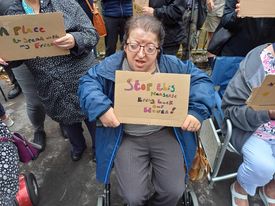
At the start of this week, we had another protest about Tudor Street Day Centre, a campaign which I've previously written about here and here.

I was going to write about this protest earlier than this, but to be completely upfront and personal, I haven't been mentally stable enough to do so. My mental health has fluctuated a lot since I was a child; sometimes I just find it too overwhelming to really put my mind to the cause of activism. This year in particular has so far been quite difficult for me, both because of events in my personal life (had a couple of bereavements and just various other difficult things going on) and because there is so much in the world that I want to sort out that I feel like I'm not always quite sure where to start. This world is so incredibly overwhelming, and with constant warnings about things like climate change, artificial intelligence and the risk of nuclear war, it can cause us to just go a bit crazy. I know this as well as anyone.

The tragic thing is that this feeling, of being utterly hopeless and unable to change our circumstances, is the very thing preventing us from doing so. If you find the energy to fight and change your circumstances, not only might you be successful in changing them but the fight itself becomes somewhat therapeutic. You'll meet people who have similar feelings to you, be able to share ideas and maybe gain the knowledge that you're helping someone, somewhere.

That's what I want to get onto here. As I've written about before, I'm heavily involved in the campaign to save Tudor Street Day Centre, a building in Abergavenny, South Wales that prior to closure in 2020 was a hub for adults with learning difficulties and mental health problems. This is a somewhat smaller and less national campaign than previous campaigns I've worked on. I got involved because my partner Owen used to work there before he met me, and last year published the novel Vulnerable Voices, which is loosely inspired by his experiences in this role. Around the time of the publication of the novel, Owen started talking more to the people from his former workplace that partially inspired its characters, found out that Monmouthshire County Council was dragging its feet about re-opening it subsequently to COVID and started a campaign for the building's reuse. I've used my experience of protest and of social campaigns to contribute to the movement as best I can.

Now it's about a year later - the council was extremely destructive for a while and to an extent still is being, but I do think there is a sense that we're winning. One thing that has disappointed me though is that occasionally I've felt that there's a slight level of snobbishness from other activists I know. I'm not thinking of anyone in particular (in truth, most of the people who have been like this I don't even know personally, they're just people I've interacted with on online forums) but I think there is a feeling that in the grand scheme of things a campaign like this perhaps doesn't matter as much as other things. And I think this is a real shame. Truthfully, this has been one of the most fulfilling campaigns I've worked on. It's been amazing to witness a group of very vulnerable people and their carers, people who often don't have the time and energy to speak out or feel at all empowered to do so, get behind a campaign to actually stick up for their rights. That's one of the things that has meant this one matter so much to me. Often at protests, it's just the same old faces over and over again - people like myself who already have a strong sense of standing up for what is right. This time, for the first time ever since I've started protesting, it's predominantly people who have no experience of this kind of thing at all, people who just want things back the way they used to be. And, crucially, it does seem like we might just be successful.

One of the most important things to know in life is that the world only exists from the perspective of each thing that lives on it. The Prime Minister lives on the same planet as us, but he does not exist in the same world as us - our experiences and outlooks on life are so incredibly different that we cannot possibly live in the same world. And for this reason, the only way to change the world is to change someone's world. If someone's quality of life becomes better as a result of something you've done, you've made the world a better place just by that. It doesn't need to be a big global thing you're working on, just something that makes another person happy. Making that other person happy might give them the boost they need to go and do something worthwhile themselves, and then we create a ripple effect across the whole of society. Some campaigns are of course bigger than others - I'll accept myself that the campaign I'm currently working on is a lot smaller in scale than a cause like fighting climate change - but that does not make it less valuable. And that doesn't mean it's not time well-spent.

We can all be activists, and we should be. Everyone has different skills and different levels of ability. Merely talking to someone can be activism, if you're saying the right things. I think there is hardly anyone, no matter what situation they're in, who isn't at some point in a position to do something to make the world better. You just need to acknowledge that fact, and take those opportunities when they come.


Here's a news report of our protest at the start of this week:


My Facebook My Twitter

Monday, 7 August 2023

The disabled are more seen than ever before, but don't be fooled

 In 2021, deaf actress Rose Ayling-Ellis won Strictly Come Dancing. In April of this year, Mattel released a Down's syndrome Barbie doll. From 2001 to 2004, we had a blind Home Secretary in David Blunkett. There are prominent actors with disabilities in major soaps and films, and in March of this year James Martin, an actor from Northern Ireland, became the first ever person with Down's Syndrome to win an Oscar. So it's fair to say that things for the disabled are the best they've ever been and only improving, right?

Wrong. Absolutely wrong. Not even slightly right. In fact, I'd even go as far as to suggest that the constant push to get a few disabled people into positions of visibility is a deliberate smokescreen to hide what an absolute mess the Government, local councils and corporations have made of disability services in the UK. In 2019, the UN rapporteur on extreme poverty condemned the UK Government for having violated its duties to its disabled citizens through 'sustained and widespread cuts to social support'. And, although we've had three different Prime Ministers since then, that Government is still in power and these problems are still continuing to perpetuate. I think anyone who has a disability, or has a loved one who has one, will have witnessed how utterly corrosive, ableist and discriminatory disability services are. I've been following this myself for a while, but over the last year I've been able to observe some of it directly, through my involvement with the campaign to save Tudor Street Day Centre in Abergavenny.

Back in December I wrote a blog about a protest we held outside this former Hub for the disabled, which has been kept firmly locked since it was forced to close over the 2020 lockdown period, in spite of there seemingly being no particular reason the building could not be re-opened. I got involved in this campaign through my partner, author and disability rights campaigner Owen B Lewis, who before we met was a staff member at this building for nearly seven years. Shortly after coming out of lockdown, Owen wrote a novel called Vulnerable Voices, which is partly based on his experiences in this line of work (although it is absolutely a work of fiction). Watching Owen write this novel, and having the honour of meeting some of the service-users who partly inspired its characters, really shone a light to me on the importance of giving these people a regular place to go, that is safe and enjoyable, where they can make new friends and learn skills, and also potentially give their carers some respite from looking after them. Shortly after that, we learned that the Tudor Street Day Centre was to be sold off, as, in Monmouthshire County Council's opinion, it was no longer needed or desired (what has actually happened since COVID is increasing isolation for Abergavenny's disabled, and the small amount of care they are receiving largely consisting of being walked around the town and taken to cafes).

Thankfully, since that time our campaign has been quite successful. The decision to sell off the day centre was revisited, and we even got a resignation from the Cabinet Member for Social Care, Safeguarding and Accessible Health Services, when Labour's Tudor Thomas was replaced by the Green Party's Ian Chandler. There was a big review of the services undertaken by Practice Solutions, which overwhelmingly pointed to the need for a regular base for these service users as there was before (which Tudor Street is the only local building capable of providing). There have been some amazing protests, incredible speeches at council meetings and there's really a feeling of optimism amongst the campaigners. I will cautiously say that I think we have a good chance of winning this and getting the day centre re-opened.

But I'll reiterate my optimism is cautious. Because even at this stage, it will take a real fight. Monmouthshire County Council is not backing down. At a recent scrutiny meeting, Councillor Simon Howarth argued that with a bit of TLC, Tudor Street Day Centre could be re-opened within a matter of days. Needless to say, this has not happened! The council has admitted that there needs to be a better base than there is, and has shortlisted three buildings (including Tudor Street Day Centre) as potential candidates. However, all evidence suggests that the other two buildings are absolutely not fit for purpose. Councillor Sue Riley raised this point at the scrutiny meeting; it was ignored, she raised it again and then the chair actually reprimanded her for asking the same question twice! Never mind that her very relevant points had not been answered at all. Worse than that, in my personal viewpoint, is the arrogance of Monmouthshire County Council here. I do not see any evidence that Councillor Chandler is any more sympathetic to the rights and dignity of the disabled than Councillor Thomas was. I've witnessed Councillor Chandler be dismissive and condescending, both to individuals in emails and in public to all the people who passionately stated their urgent needs to get the Hub re-opened. Worse than that was the fact that many staff members, dedicated carers who the disabled rely on, were threatened against even attending that meeting. There are two major problems with this: first, this diluted the level of support for this cause that was allowed to be expressed. But worse than that, many of these carers had intended to bring service users with them in their cars. The decision to prevent these carers attending meant that there were many service users who weren't able to attend unless they had a family member who could bring them, and many don't. I'm cynical, but I wonder if this was the intention.

I've embedded a link to the scrutiny meeting below (it's about three hours long). Towards the end, the livestream was stopped when Owen and I talked over the chair and continued to question Councillor Chandler. We were berated for this quite strongly afterwards, but I absolutely stand by what we did - because the plain truth was, we simply were not being listened to. Councillor Chandler's indifference to people's feelings was such that at one point, they used the phrase 'final solution' when talking about the eventual conclusion of the review, a phrase that has well-known Nazi connotations. To be fair to Councillor Chandler, I believe that this was a genuine mistake and just a poor choice of words, rather than a deliberate dog-whistle. But still, when a slip of the tongue is that extreme it does speak to the fact that someone just isn't thinking about how they might come across to the vulnerable people in the room whose quality of life directly depends on the decision made. This comment was callous and insensitive, even if it wasn't deliberate.

I've talked at length about this particular instance purely because it's the one that I myself am actively involved in. But there are similar things happening around the country, and it has to stop. The stage adaptation of Vulnerable Voices was on in Bristol in May, generating this wonderful review. For this project, we intended to find some actors with disabilities to play the service-users, and I'm glad to say we found some amazing ones. But finding them was such a struggle. Bristol has a disability theatre company called Misfits (not the most empowering name, is it?) We contacted this company, and truthfully I felt that they were actively obstructive in helping us find local disabled talent. They were discouraging and negative in the way they interacted with us. They consistently kept us waiting a very long time to hear back from them. We weren't allowed to be introduced to any of their performers. They said they'd pass on our casting call to certain people, but I have no evidence that they did, or that they were at all positive in the way that they put this across (sometimes, particularly in the case of learning difficulties, people need a bit of encouragement to put themselves forward for things). And unfortunately, the same was true for disability acting agencies we contacted. We did in the end find some extremely talented actors with disabilities to be in our show, who did an amazing job and whom we really hope to work with again in the future - but all of them were found either through personal recommendations or through social media. No one who was supposed to be in the position of helping disabled actors find work was remotely helpful to us in this. We talk so much about the importance of representation (and it is bloody important) - but maybe the reason there isn't enough of it is that when someone is actually looking to do some, they get treated like this?

Back in January, I wrote an incredibly personal blog about the problems I have with saying that LGBTQ+ actors should play LGBTQ+ parts. In this blog, I touched on my annoyance that a lot of the people making this argument are the very people who oppressed LGBTQ+ actors in the past, who are now leaping on the bandwagon. I think the same is largely true for disability portrayals. Yes, there are a few more disabled celebrities now than there used to be - but it's just the same people popping up over and over again, and that doesn't solve a general trend within society. The most incredible example I've come across of the cynicism involved in disability casting is when a photo was taken of the set of Doctor Who, which featured a ramp on the entrance to the TARDIS. Someone in a Doctor Who Facebook page I was in said, 'Ooh, does this mean Ruth Madeley is joining the cast?' And a few months later, it was revealed that yes, she is. The fact that not only did the appearance of an accessibility ramp immediately make someone guess at a specific wheelchair user joining, but that actually that person was correct in their prediction, speaks volumes to me. I have no issue with Ruth Madeley. I actually like her as an actress, I've seen her in a few things and I always enjoy her performances. But why is it automatically assumed that a wheelchair-user in a popular TV programme in the UK will be played by her? And why do those assumptions turn out to be correct, like in this case? Is that what groups like Disabled People Against Cuts are campaigning for - one single individual with a disability to get more and more work, without any increase in the opportunities for other individuals with the same kinds of things? I don't think so.

I'm so happy for anyone who's achieved something special in their life, especially if they've really struggled to get there as a lot of disabled people have. But having a few disabled people turning up in everything and getting a hell of a lot of promotion does not make life any better for the overwhelming majority of disabled people. In fact, I think there's an argument it actually makes it more difficult, as it suggests to the public that we're improving, and we're not. We are not improving. The lives of ordinary disabled people in places like Abergavenny are far worse than they were even five years ago. We can do better than this, and we should.

The Scrutiny Meeting:


Some pictures from a recent protest (we have another coming up on Tuesday 15th August. ITV News are coming, so hopefully we'll get some decent coverage.)


Sunday, 16 July 2023

Orwell's Nineteen Eighty-Four is a fantastic social satire - but it is still a work of fiction

 George Orwell's Nineteen Eighty-Four is one of my favourite books. I devoured it on holiday in Copenhagen when I was about fifteen (surprisingly, I don't believe I've reread it since - I should do, I'm sure it's even better than I took on board as an impressionable teenager). It's also the book that got my partner, who struggles with dyslexia, to truly enjoy the art of reading - this was only four years ago, and he's now a published author of two novels so we owe a lot to George Orwell!

In addition to being a great story, it's also so incredibly accurate as a cautionary tale. If you like to discuss political and social issues within left-wing circles, it's impossible to avoid comparisons between day-to-day life in the United Kingdom in 2023 to day-to-day life in Airstrip One, Oceania. There are memes shared around frequently with messages like 'Someone tell the Tories Orwell wrote Nineteen Eighty-Four as a warning, not as a fucking instruction manual!' And they have a point. Be it discouragement of independent thought, the invention of a perpetual enemy, the increasing merging of words making it harder to express original thoughts or the boundaries between truth and fiction becoming more and more blurred, a lot of the stimuli we experience around us does resemble in ever-more disturbing ways the world that Orwell was warning us about. However, I feel that in some ways, Orwell's work is interpreted a little too literally, and with negative effects.

This post was inspired by a conversation I had with someone in the comments thread on the Facebook page of my favourite blogger, Tom Clark of Another Angry Voice (which is really worth reading, anyone who doesn't already). The conversation involved the fact that multiple MPs, many of whom are very decent such as Caroline Lucas and Mhairi Black, have decided to step down at the next election. The discussion moved on to how toxic the Westminster system is and how anyone who goes in genuinely wanting to help people finds themselves driven out by the cruel, bullying public school boys' club. Someone gave Jeremy Corbyn as an example of this. I pointed out that he hasn't announced that he's still there and hasn't been destroyed. They argued that his movement and transformative agenda has. I said that if that had been destroyed, the Labour Party wouldn't still be panicking so much about trying to crush it.

Someone in that conversation responded by saying that Jeremy Corbyn has become our Emmanuel Goldstein, and went on to write the following:

'The new grass roots movement Corbyn helped create has been destroyed utterly, ploughed into the grown and sown with salt. There's nothing left now. The left are finished in this country, those few of us who remain are like the last few dazed, lumbering dinosaurs stumbling around after the asteroid impact. It's their world now - the far right fascists, swindlers, crooks and robber barons, racists, boot boys, bigots, gammons, Daily Mail fodder, Incel shitheads. The future belongs to them, we are the dead. They never will be better. We're done for, it's over, welcome to hell. The end.'

Now, irrespective of how disillusioned one is with modern politics (and let's face it, there's A LOT to be disillusioned about) I don't think that's a very healthy attitude to have. I also don't think it's an attitude George Orwell would have approved of, although obviously I don't know for sure. If he had believed in this, though, I wouldn't see why he put so much time and energy into writing an amazing book about it all.

This encounter made me think of all the Orwell references I come across, day-by-day, week-by-week... and I came to realise that a lot of them, even if they're sincere and intelligent, are actually really not very productive. They're used not to improve the future, but just to bemoan the situation we're currently in. They're utterly devoid of hope, or of any action we can take to try to improve things for ourselves. I don't believe that's what the novel Nineteen Eighty-Four is for.

Let's get a few things very clear. Number one, George Orwell may have been remarkably prescient in seeing where society was going, but he did not have access to a time machine. The reason he was able to predict things so accurately was because he wasn't really writing about the future, he was writing about what was at the time the present. He could see how callous, dictatorial and frightening our way of living was (curiously enough, during the very decade when we got the NHS and great social reform) and all he did in Nineteen Eighty-Four was follow things to their extreme logical conclusion. It's depressing that so far we haven't got off that track yet - but that doesn't mean we couldn't have done.

Secondly, I feel that people look at Orwell's work as though it's an inevitable, unavoidable part of what it means to be a human being living amongst other human beings. It is not. The outcome of a book is fixed - no matter how many times you read it, the ending remains the same. Winston and Julia's journey was futile to begin with, because the author decided it was. But we are not characters in a book, we are real people with control over our destiny. It doesn't have to be like this. We can create a society that isn't like the one Orwell warned us about. There are truly fair societies in the world (normally the ones capitalism hasn't touched yet) and it is a deliberate political choice not to adopt the same principles in our own. It is possible to break down the racist, sexist, ablest, classist, capitalist power structures defining our world, and start again in a way that is more caring to one another and to our environment.

Will we do that? I don't know. Like George Orwell and everyone else, I am incapable of truly predicting the future. Like George Orwell, I could hazard an educated guess by following our current social trends to their extreme conclusion - but I think I will not do that, both because the answer would be very depressing and also because I don't think it would be productive. But I feel secure in the knowledge that changing the way we live is possible. Not only is it possible, it is essential.

Read George Orwell's work, because it's amazing, and take it for what it was meant to be. Use it in the way you act, to make sure that we aren't living lives like those experienced by his characters. But do not take it and internalise that we have a fixed destiny that we can do nothing about. Life is WAY too fluid for that shit.