About me

Wednesday, 23 August 2023

This time last week, no one cared whether murderers were around to hear their sentence

 Like everyone else in the UK, I've spent the last half a week unhealthily fixated on the disturbing case of Lucy Letby, the smiley and seemingly kind young nurse who was found guilty on Friday of being one of the most prolific child murderers in history, seemingly without any motive or any history of any kind of criminal behaviour. The case has baffled psychologists, and shines a light on the inherent problems within NHS hierarchy, where doctors' concerns about Letby's conduct were repeatedly ignored.

This is clearly a deeply disturbing case for many reasons. Stories involving people who hurt children will always be emotive, and when the perpetrator is in a position of trust and looks to be what we think of as a 'normal person' it's even more so. Letby herself was quite rightly sentenced to life for each child she was found guilty of murdering, and ordered to serve what is called a 'whole life tariff', meaning her case will not be considered by the parole board and she will therefore never be released from jail. I'm not entirely sure I agree with whole-life tariffs; since their introduction in 1983, it seems like they've benefitted politicians more than anyone else. But on the other hand, so many violent criminals are released from prison when they clearly have not been rehabilitated and go on to reoffend that I wouldn't say I exactly object to Lucy Letby getting one. Let's just say that of all the improvements I would make to the criminal justice system, the abolition of whole-life tariffs would not be in the top ten.

I've been intrigued though that the part of this case that we seem to be focussing most strongly on is the fact that she decided not to come to court for the last few days of her trial, meaning she missed her guilty verdicts, the victim impact statements and her sentencing. There have been howls of outrage from the media and from the general public over this, and calls for the law to be changed so that murderers are forced to attend court and hear these things. In a recent poll in The Mirror, 95% of respondents said that they believed murderers should be forced to attend, 4% said they shouldn't and 1% weren't sure. That is an astonishingly high level of agreement in this day and age.

I was one of the 4% who said they shouldn't, as although I understand the impulse, I'm really not sure that this idea has been thought through, for a number of reasons. Firstly because how realistically would this work? If the person was determined not to come, it would take a lot of manpower to physically drag them from their cell. Even if they were forced to appear in the dock, how do you make them be respectful? How do you stop them from struggling to escape, or singing loudly so no one can hear? Charge them with contempt of court? Where's the deterrent in that, if they're never getting out anyway? Gag them? Tie them up? Sedate them? More? Is that the best use of taxpayers' money? Even if we did work out some way of forcing a convicted criminal to sit quietly, wouldn't all of this be far more traumatic for the victims of the person's crimes? This is meant to be about them, not about the perpetrator.

Some people have suggested that rather than forcing someone to appear in person, to have the impact statements transmitted to their cell via a video link, in a way that they cannot turn it off. This is a slightly more reasonable suggestion, however it's still fraught with flaws. It's still possible to zone out and ignore what you're being shown; you can't force someone to really take in what you're saying to them. And also, I think in the Letby case specifically, there's a massive elephant in the room that we aren't taking into account. Lucy Letby is a grief addict. Her only motive for these horrific acts seems to be that she enjoys being around people who are suffering. It wasn't enough for her to simply kill the babies; she wanted to be around the victims afterwards, watch their grief, dress the children in their funeral outfits, search for posts on social media. Wouldn't forcing her to hear the impact statements actually have the potential to be pleasurable for her? It's sickening to think of grieving parents reading their impact statements and the person who caused that grief to be listening and getting off on it. Not that I've ever been in that situation, but it seems far more appropriate for these people to be reading this stuff in a room full of people who care and have empathy for them.

Although the idea of forcing murderers to hear their sentences isn't very practical, I can't blame individual members of the public for thinking it. The idea of a beloved nurse, someone who has been entrusted to care for your baby, abusing her position in such a hideous way is obscene. It's natural to be deeply upset, and a bit reactionary, when you hear about something as horrible as this. We aren't thinking straight, and that's to be expected. What isn't right is the fact that the media has taken advantage of people's grief in this way. The media should be our beacon of social responsibility; to present the news in a factual and logical way, and for us to be able to rely on what we're being told. In constantly reporting on the calls to force murderers to attend court, journalists are deliberately exploiting the victims of Lucy Letby, and the human compassion that society feels for them, to sell their product. I find this deeply offensive.

And then there's this.


Look at these reactions from the Prime Minister, the Justice Secretary and the Leader of the Opposition.

Are they looking to create better bereavement services for families who have lost a child? No. Are they looking to fund the NHS more, so that more babies can be saved? No. Are they looking to improve NHS training and reporting procedures, in the hope that staff members like Letby can be noticed and stopped sooner? No. Their primary interest is in forcing murderers to attend their sentences - something that actually, in the grand scheme of things, is not the most important thing about this case. Deciding not to come to court was undoubtedly one last cowardly fuck-you from Lucy Letby to the people she hurt - but that's just the kind of person she obviously is. It's not going to make any difference, either to her punishment or the ability of her victims to come to terms with what has been done to them and move on with their lives, whether she's there in person to hear the sentences or not.

Let's be clear: over the last two decades, both the Labour and Conservative party have spent prolonged periods in Government. They've both had plenty of opportunity to change the law to force murderers to come to court, especially given that they're in such strong agreement about it. But they didn't, because they didn't care. And they don't care now. That's not what this is about. This is about opportunism. The only reason that senior politicians from both the main parties are in such strong agreement with each other is to win votes from the reactionary public. That is literally it. Their senior strategists were probably rubbing their hands with glee at Lucy Letby's behaviour. It's a great opportunity for them. Immediately scramble to be the first one to condemn Lucy Letby and complain about the processes that mean she was allowed to stay in her cell and not look her victims in the eye. No one can possibly disagree with them about this without looking like they're on the side of one of the worst human beings on the planet. They're exploiting the grief of families, and the human empathy of the general public, to add a few brownie points onto whatever sour version of neoliberalism they're cooking up this week. That is disgusting. I don't even have words for how grotesque that is.

The most insulting part about all of this is that neither of the two main parties actually care about children. If you think politicians' sympathy for families in the Lucy Letby case is the slightest bit sincere, look at what they're actually doing that is harming children and families now. You know what Keir Starmer's nickname is since announcing he won't backtrack on the two-child benefit cap? Sir Kid Starver. This system is causing children to grow up severely malnourished. Teachers report that kids are coming to school so hungry they are eating rubbers. And what about non-white children? Where is the concern for the children on refugee boats? Where is the concern for children in Palestine? Do they count? I consider both the Labour and Conservative parties to be culpable for these things - the Conservatives have actually done it, but Labour has not sufficiently stood against it, or reassured me that they'd do much better if elected. Thankfully, I will say that a lot of the comments on these politicians' posts have been calling them out for this behaviour; at least it doesn't seem to be working as well as I'd feared it would. If there's one good thing about cases like this, it's that it shows how caring most people are, how shocked and upset we become on behalf of people who have lost a child in this way.

There will always be Lucy Letbys. Unfortunately, for some reason we don't know yet, some individuals just seem to have an insatiable desire to harm others, often the most vulnerable people. Those people are often drawn to professions such as nursing where they'll have easy access to victims. Thankfully, these people are quite rare, and even when they do turn up there are usually red flags we can look out for. A big part of the reason this particular case has been so newsworthy is that she doesn't fit the typical profile of someone who commits these acts, and that is highly unusual - plus, because she's an attractive middle-class white girl, which highlights our inherent racism, sexism and classism as a society. We can learn to spot these people, and to come together to support the people they've hurt. Using their crimes as a publicity opportunity does not help. Quite the contrary; it makes it far harder.


My Facebook My Twitter

Saturday, 19 August 2023

Anyone can be an activist; just focussing on what needs doing where you are is enough

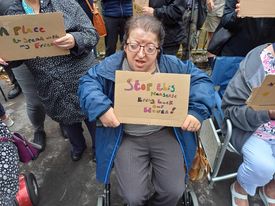
At the start of this week, we had another protest about Tudor Street Day Centre, a campaign which I've previously written about here and here.

I was going to write about this protest earlier than this, but to be completely upfront and personal, I haven't been mentally stable enough to do so. My mental health has fluctuated a lot since I was a child; sometimes I just find it too overwhelming to really put my mind to the cause of activism. This year in particular has so far been quite difficult for me, both because of events in my personal life (had a couple of bereavements and just various other difficult things going on) and because there is so much in the world that I want to sort out that I feel like I'm not always quite sure where to start. This world is so incredibly overwhelming, and with constant warnings about things like climate change, artificial intelligence and the risk of nuclear war, it can cause us to just go a bit crazy. I know this as well as anyone.

The tragic thing is that this feeling, of being utterly hopeless and unable to change our circumstances, is the very thing preventing us from doing so. If you find the energy to fight and change your circumstances, not only might you be successful in changing them but the fight itself becomes somewhat therapeutic. You'll meet people who have similar feelings to you, be able to share ideas and maybe gain the knowledge that you're helping someone, somewhere.

That's what I want to get onto here. As I've written about before, I'm heavily involved in the campaign to save Tudor Street Day Centre, a building in Abergavenny, South Wales that prior to closure in 2020 was a hub for adults with learning difficulties and mental health problems. This is a somewhat smaller and less national campaign than previous campaigns I've worked on. I got involved because my partner Owen used to work there before he met me, and last year published the novel Vulnerable Voices, which is loosely inspired by his experiences in this role. Around the time of the publication of the novel, Owen started talking more to the people from his former workplace that partially inspired its characters, found out that Monmouthshire County Council was dragging its feet about re-opening it subsequently to COVID and started a campaign for the building's reuse. I've used my experience of protest and of social campaigns to contribute to the movement as best I can.

Now it's about a year later - the council was extremely destructive for a while and to an extent still is being, but I do think there is a sense that we're winning. One thing that has disappointed me though is that occasionally I've felt that there's a slight level of snobbishness from other activists I know. I'm not thinking of anyone in particular (in truth, most of the people who have been like this I don't even know personally, they're just people I've interacted with on online forums) but I think there is a feeling that in the grand scheme of things a campaign like this perhaps doesn't matter as much as other things. And I think this is a real shame. Truthfully, this has been one of the most fulfilling campaigns I've worked on. It's been amazing to witness a group of very vulnerable people and their carers, people who often don't have the time and energy to speak out or feel at all empowered to do so, get behind a campaign to actually stick up for their rights. That's one of the things that has meant this one matter so much to me. Often at protests, it's just the same old faces over and over again - people like myself who already have a strong sense of standing up for what is right. This time, for the first time ever since I've started protesting, it's predominantly people who have no experience of this kind of thing at all, people who just want things back the way they used to be. And, crucially, it does seem like we might just be successful.

One of the most important things to know in life is that the world only exists from the perspective of each thing that lives on it. The Prime Minister lives on the same planet as us, but he does not exist in the same world as us - our experiences and outlooks on life are so incredibly different that we cannot possibly live in the same world. And for this reason, the only way to change the world is to change someone's world. If someone's quality of life becomes better as a result of something you've done, you've made the world a better place just by that. It doesn't need to be a big global thing you're working on, just something that makes another person happy. Making that other person happy might give them the boost they need to go and do something worthwhile themselves, and then we create a ripple effect across the whole of society. Some campaigns are of course bigger than others - I'll accept myself that the campaign I'm currently working on is a lot smaller in scale than a cause like fighting climate change - but that does not make it less valuable. And that doesn't mean it's not time well-spent.

We can all be activists, and we should be. Everyone has different skills and different levels of ability. Merely talking to someone can be activism, if you're saying the right things. I think there is hardly anyone, no matter what situation they're in, who isn't at some point in a position to do something to make the world better. You just need to acknowledge that fact, and take those opportunities when they come.


Here's a news report of our protest at the start of this week:


My Facebook My Twitter

Monday, 7 August 2023

The disabled are more seen than ever before, but don't be fooled

 In 2021, deaf actress Rose Ayling-Ellis won Strictly Come Dancing. In April of this year, Mattel released a Down's syndrome Barbie doll. From 2001 to 2004, we had a blind Home Secretary in David Blunkett. There are prominent actors with disabilities in major soaps and films, and in March of this year James Martin, an actor from Northern Ireland, became the first ever person with Down's Syndrome to win an Oscar. So it's fair to say that things for the disabled are the best they've ever been and only improving, right?

Wrong. Absolutely wrong. Not even slightly right. In fact, I'd even go as far as to suggest that the constant push to get a few disabled people into positions of visibility is a deliberate smokescreen to hide what an absolute mess the Government, local councils and corporations have made of disability services in the UK. In 2019, the UN rapporteur on extreme poverty condemned the UK Government for having violated its duties to its disabled citizens through 'sustained and widespread cuts to social support'. And, although we've had three different Prime Ministers since then, that Government is still in power and these problems are still continuing to perpetuate. I think anyone who has a disability, or has a loved one who has one, will have witnessed how utterly corrosive, ableist and discriminatory disability services are. I've been following this myself for a while, but over the last year I've been able to observe some of it directly, through my involvement with the campaign to save Tudor Street Day Centre in Abergavenny.

Back in December I wrote a blog about a protest we held outside this former Hub for the disabled, which has been kept firmly locked since it was forced to close over the 2020 lockdown period, in spite of there seemingly being no particular reason the building could not be re-opened. I got involved in this campaign through my partner, author and disability rights campaigner Owen B Lewis, who before we met was a staff member at this building for nearly seven years. Shortly after coming out of lockdown, Owen wrote a novel called Vulnerable Voices, which is partly based on his experiences in this line of work (although it is absolutely a work of fiction). Watching Owen write this novel, and having the honour of meeting some of the service-users who partly inspired its characters, really shone a light to me on the importance of giving these people a regular place to go, that is safe and enjoyable, where they can make new friends and learn skills, and also potentially give their carers some respite from looking after them. Shortly after that, we learned that the Tudor Street Day Centre was to be sold off, as, in Monmouthshire County Council's opinion, it was no longer needed or desired (what has actually happened since COVID is increasing isolation for Abergavenny's disabled, and the small amount of care they are receiving largely consisting of being walked around the town and taken to cafes).

Thankfully, since that time our campaign has been quite successful. The decision to sell off the day centre was revisited, and we even got a resignation from the Cabinet Member for Social Care, Safeguarding and Accessible Health Services, when Labour's Tudor Thomas was replaced by the Green Party's Ian Chandler. There was a big review of the services undertaken by Practice Solutions, which overwhelmingly pointed to the need for a regular base for these service users as there was before (which Tudor Street is the only local building capable of providing). There have been some amazing protests, incredible speeches at council meetings and there's really a feeling of optimism amongst the campaigners. I will cautiously say that I think we have a good chance of winning this and getting the day centre re-opened.

But I'll reiterate my optimism is cautious. Because even at this stage, it will take a real fight. Monmouthshire County Council is not backing down. At a recent scrutiny meeting, Councillor Simon Howarth argued that with a bit of TLC, Tudor Street Day Centre could be re-opened within a matter of days. Needless to say, this has not happened! The council has admitted that there needs to be a better base than there is, and has shortlisted three buildings (including Tudor Street Day Centre) as potential candidates. However, all evidence suggests that the other two buildings are absolutely not fit for purpose. Councillor Sue Riley raised this point at the scrutiny meeting; it was ignored, she raised it again and then the chair actually reprimanded her for asking the same question twice! Never mind that her very relevant points had not been answered at all. Worse than that, in my personal viewpoint, is the arrogance of Monmouthshire County Council here. I do not see any evidence that Councillor Chandler is any more sympathetic to the rights and dignity of the disabled than Councillor Thomas was. I've witnessed Councillor Chandler be dismissive and condescending, both to individuals in emails and in public to all the people who passionately stated their urgent needs to get the Hub re-opened. Worse than that was the fact that many staff members, dedicated carers who the disabled rely on, were threatened against even attending that meeting. There are two major problems with this: first, this diluted the level of support for this cause that was allowed to be expressed. But worse than that, many of these carers had intended to bring service users with them in their cars. The decision to prevent these carers attending meant that there were many service users who weren't able to attend unless they had a family member who could bring them, and many don't. I'm cynical, but I wonder if this was the intention.

I've embedded a link to the scrutiny meeting below (it's about three hours long). Towards the end, the livestream was stopped when Owen and I talked over the chair and continued to question Councillor Chandler. We were berated for this quite strongly afterwards, but I absolutely stand by what we did - because the plain truth was, we simply were not being listened to. Councillor Chandler's indifference to people's feelings was such that at one point, they used the phrase 'final solution' when talking about the eventual conclusion of the review, a phrase that has well-known Nazi connotations. To be fair to Councillor Chandler, I believe that this was a genuine mistake and just a poor choice of words, rather than a deliberate dog-whistle. But still, when a slip of the tongue is that extreme it does speak to the fact that someone just isn't thinking about how they might come across to the vulnerable people in the room whose quality of life directly depends on the decision made. This comment was callous and insensitive, even if it wasn't deliberate.

I've talked at length about this particular instance purely because it's the one that I myself am actively involved in. But there are similar things happening around the country, and it has to stop. The stage adaptation of Vulnerable Voices was on in Bristol in May, generating this wonderful review. For this project, we intended to find some actors with disabilities to play the service-users, and I'm glad to say we found some amazing ones. But finding them was such a struggle. Bristol has a disability theatre company called Misfits (not the most empowering name, is it?) We contacted this company, and truthfully I felt that they were actively obstructive in helping us find local disabled talent. They were discouraging and negative in the way they interacted with us. They consistently kept us waiting a very long time to hear back from them. We weren't allowed to be introduced to any of their performers. They said they'd pass on our casting call to certain people, but I have no evidence that they did, or that they were at all positive in the way that they put this across (sometimes, particularly in the case of learning difficulties, people need a bit of encouragement to put themselves forward for things). And unfortunately, the same was true for disability acting agencies we contacted. We did in the end find some extremely talented actors with disabilities to be in our show, who did an amazing job and whom we really hope to work with again in the future - but all of them were found either through personal recommendations or through social media. No one who was supposed to be in the position of helping disabled actors find work was remotely helpful to us in this. We talk so much about the importance of representation (and it is bloody important) - but maybe the reason there isn't enough of it is that when someone is actually looking to do some, they get treated like this?

Back in January, I wrote an incredibly personal blog about the problems I have with saying that LGBTQ+ actors should play LGBTQ+ parts. In this blog, I touched on my annoyance that a lot of the people making this argument are the very people who oppressed LGBTQ+ actors in the past, who are now leaping on the bandwagon. I think the same is largely true for disability portrayals. Yes, there are a few more disabled celebrities now than there used to be - but it's just the same people popping up over and over again, and that doesn't solve a general trend within society. The most incredible example I've come across of the cynicism involved in disability casting is when a photo was taken of the set of Doctor Who, which featured a ramp on the entrance to the TARDIS. Someone in a Doctor Who Facebook page I was in said, 'Ooh, does this mean Ruth Madeley is joining the cast?' And a few months later, it was revealed that yes, she is. The fact that not only did the appearance of an accessibility ramp immediately make someone guess at a specific wheelchair user joining, but that actually that person was correct in their prediction, speaks volumes to me. I have no issue with Ruth Madeley. I actually like her as an actress, I've seen her in a few things and I always enjoy her performances. But why is it automatically assumed that a wheelchair-user in a popular TV programme in the UK will be played by her? And why do those assumptions turn out to be correct, like in this case? Is that what groups like Disabled People Against Cuts are campaigning for - one single individual with a disability to get more and more work, without any increase in the opportunities for other individuals with the same kinds of things? I don't think so.

I'm so happy for anyone who's achieved something special in their life, especially if they've really struggled to get there as a lot of disabled people have. But having a few disabled people turning up in everything and getting a hell of a lot of promotion does not make life any better for the overwhelming majority of disabled people. In fact, I think there's an argument it actually makes it more difficult, as it suggests to the public that we're improving, and we're not. We are not improving. The lives of ordinary disabled people in places like Abergavenny are far worse than they were even five years ago. We can do better than this, and we should.

The Scrutiny Meeting:


Some pictures from a recent protest (we have another coming up on Tuesday 15th August. ITV News are coming, so hopefully we'll get some decent coverage.)


Sunday, 16 July 2023

Orwell's Nineteen Eighty-Four is a fantastic social satire - but it is still a work of fiction

 George Orwell's Nineteen Eighty-Four is one of my favourite books. I devoured it on holiday in Copenhagen when I was about fifteen (surprisingly, I don't believe I've reread it since - I should do, I'm sure it's even better than I took on board as an impressionable teenager). It's also the book that got my partner, who struggles with dyslexia, to truly enjoy the art of reading - this was only four years ago, and he's now a published author of two novels so we owe a lot to George Orwell!

In addition to being a great story, it's also so incredibly accurate as a cautionary tale. If you like to discuss political and social issues within left-wing circles, it's impossible to avoid comparisons between day-to-day life in the United Kingdom in 2023 to day-to-day life in Airstrip One, Oceania. There are memes shared around frequently with messages like 'Someone tell the Tories Orwell wrote Nineteen Eighty-Four as a warning, not as a fucking instruction manual!' And they have a point. Be it discouragement of independent thought, the invention of a perpetual enemy, the increasing merging of words making it harder to express original thoughts or the boundaries between truth and fiction becoming more and more blurred, a lot of the stimuli we experience around us does resemble in ever-more disturbing ways the world that Orwell was warning us about. However, I feel that in some ways, Orwell's work is interpreted a little too literally, and with negative effects.

This post was inspired by a conversation I had with someone in the comments thread on the Facebook page of my favourite blogger, Tom Clark of Another Angry Voice (which is really worth reading, anyone who doesn't already). The conversation involved the fact that multiple MPs, many of whom are very decent such as Caroline Lucas and Mhairi Black, have decided to step down at the next election. The discussion moved on to how toxic the Westminster system is and how anyone who goes in genuinely wanting to help people finds themselves driven out by the cruel, bullying public school boys' club. Someone gave Jeremy Corbyn as an example of this. I pointed out that he hasn't announced that he's still there and hasn't been destroyed. They argued that his movement and transformative agenda has. I said that if that had been destroyed, the Labour Party wouldn't still be panicking so much about trying to crush it.

Someone in that conversation responded by saying that Jeremy Corbyn has become our Emmanuel Goldstein, and went on to write the following:

'The new grass roots movement Corbyn helped create has been destroyed utterly, ploughed into the grown and sown with salt. There's nothing left now. The left are finished in this country, those few of us who remain are like the last few dazed, lumbering dinosaurs stumbling around after the asteroid impact. It's their world now - the far right fascists, swindlers, crooks and robber barons, racists, boot boys, bigots, gammons, Daily Mail fodder, Incel shitheads. The future belongs to them, we are the dead. They never will be better. We're done for, it's over, welcome to hell. The end.'

Now, irrespective of how disillusioned one is with modern politics (and let's face it, there's A LOT to be disillusioned about) I don't think that's a very healthy attitude to have. I also don't think it's an attitude George Orwell would have approved of, although obviously I don't know for sure. If he had believed in this, though, I wouldn't see why he put so much time and energy into writing an amazing book about it all.

This encounter made me think of all the Orwell references I come across, day-by-day, week-by-week... and I came to realise that a lot of them, even if they're sincere and intelligent, are actually really not very productive. They're used not to improve the future, but just to bemoan the situation we're currently in. They're utterly devoid of hope, or of any action we can take to try to improve things for ourselves. I don't believe that's what the novel Nineteen Eighty-Four is for.

Let's get a few things very clear. Number one, George Orwell may have been remarkably prescient in seeing where society was going, but he did not have access to a time machine. The reason he was able to predict things so accurately was because he wasn't really writing about the future, he was writing about what was at the time the present. He could see how callous, dictatorial and frightening our way of living was (curiously enough, during the very decade when we got the NHS and great social reform) and all he did in Nineteen Eighty-Four was follow things to their extreme logical conclusion. It's depressing that so far we haven't got off that track yet - but that doesn't mean we couldn't have done.

Secondly, I feel that people look at Orwell's work as though it's an inevitable, unavoidable part of what it means to be a human being living amongst other human beings. It is not. The outcome of a book is fixed - no matter how many times you read it, the ending remains the same. Winston and Julia's journey was futile to begin with, because the author decided it was. But we are not characters in a book, we are real people with control over our destiny. It doesn't have to be like this. We can create a society that isn't like the one Orwell warned us about. There are truly fair societies in the world (normally the ones capitalism hasn't touched yet) and it is a deliberate political choice not to adopt the same principles in our own. It is possible to break down the racist, sexist, ablest, classist, capitalist power structures defining our world, and start again in a way that is more caring to one another and to our environment.

Will we do that? I don't know. Like George Orwell and everyone else, I am incapable of truly predicting the future. Like George Orwell, I could hazard an educated guess by following our current social trends to their extreme conclusion - but I think I will not do that, both because the answer would be very depressing and also because I don't think it would be productive. But I feel secure in the knowledge that changing the way we live is possible. Not only is it possible, it is essential.

Read George Orwell's work, because it's amazing, and take it for what it was meant to be. Use it in the way you act, to make sure that we aren't living lives like those experienced by his characters. But do not take it and internalise that we have a fixed destiny that we can do nothing about. Life is WAY too fluid for that shit.

Thursday, 29 June 2023

Why it's okay to feel sad about the Titan Five

 Over the last week, the tragic case of the Titan submersible disappearance has dominated headlines. For several days, there was a worldwide rush to trace and save the five people on board before the oxygen ran out - but ultimately, it was demonstrated that a failure of the pressure hull had caused an implosion, killing the occupants instantly.

If, like me, you move in left-wing circles, you'll almost certainly have witnessed comparisons being made to the amount of coverage that refugee boats get - in particular, this extremely disturbing instance, which happened just a couple of weeks before and vanished from news coverage pretty much instantaneously. The argument is made that it's disgusting that a group of people who were foolish enough to pay a lot of money to visit the wreck of the Titanic get this amount of media coverage when people fleeing for their lives get practically zero sympathy, and certainly nothing like the level of public attention and resources. I think this is an important point, and I have shared a post to this effect on my own social media profile.

However, as valid a concern as this is, I also think there's an extent to which it can go too far. I've been quite upset by some of the posts I've seen essentially suggesting that in the circumstances it would have been all right to just ignore the submersible and forget about its occupants. After all, they're only billionaires, right?

There have been some interesting articles written about why this particular case has struck such public interest - here's one such article which I thought made for interesting reading. I have my own take on the reasons why this particular case was felt to be so deserving of media interest:


1. The social status of the people involved

The hardest thing about calling out people who make this point that billionaires might as well drown is that I do think they're half right - if not a little more than half. The ultimate reason that refugees don't get the same level of media and public attention is because they are seen in our culture at the moment as almost sub-human. Our Government has an attitude towards the most vulnerable that is in my view nothing short of sociopathic, and just on an anecdotal level, when I've been discussing these matters with strangers on the internet, I've found myself quite genuinely shocked at how callous people can be. Within the last month, I've actually debated with someone who thought that people would risk their own and their children's lives aboard dangerous boats purely out of greed, without any fear whatsoever of what could await them if they stay in their home countries. Needless to say, almost no one would do that. It's hard to debate someone who is that far removed from reality, but I did my best.

Billionaires, on the other hand, tend to have a combination of two of the most toxic things within society; cruelty and stupidity. Cruelty because it's almost impossible to earn that amount of money honestly and ethically (it's so much more than a million that the human mind can't even really fathom the difference). Even if, theoretically, someone did, I don't believe it's possible to be a good person and still keep your billionaire status. I often wish I could do more to help the people who are struggling most, and the only reason I don't is that I just don't have enough money. If I had that much, enough to give huge amounts away and still be comfortably off, of course I would do it - I wouldn't even have to think about it. If you don't, with the amount of suffering around you, that is the definition of cruelty. And stupidity because it's my belief that insane amounts of power and wealth cause one to believe that one is invincible. There are examples of this all over the world, but in this case it manifests itself in the fact that five people paid more money than most of us could hope to earn in a lifetime to board a submersible that it was on record was unsafe. It's so well-documented how unsafe this vessel was, how many corners had been cut, that I don't think I even need to bother sourcing this fact; I think almost everyone will have seen the video of OceanGate's executive admitting this. Actually, not even admitting; boasting would be a more accurate term.

Ultimately, some very rich people decided to chance their luck. I feel sad for them, but the decision was idiotic (arguably far more idiotic than boarding a refugee ship actually - at least people who do that are making a choice between that or a potentially worse fate).


2. The history with the Titanic

I won't go into this one in much detail because it's detailed in the Guardian article I linked above, but I think the irony is part of it. The story of the ill-fated Titanic has captured public interest for more than a century now. The definition of the word 'titanic', originally referring to something of exceptional strength and power, is now commonly used to refer to something utterly doomed. The James Cameron film Titanic, which came out in 1997, is one of the most popular films of all-time, and I think there's something about that disaster that has stuck in public consciousness when comparable ones haven't. There's something strangely romantic about a submersible named after it and inspired by it suffering a similar fate.


3. The coziness of human interest stories

This is another thing discussed in the Guardian article, but stories about people in desperate situations always capture the public mood, from the Chilean miners in 2010 to the Thai footballers in 2018. I think this is a particular phenomenon that has accompanied the rise of the Internet. This medium lends itself to stories which people can desperately seeking updates on every few hours, and the corporate media has latched onto this to milk them for all they are worth. That sounds very cynical, but I suppose there's a good aspect to it as well - at least public pressure means that there's an incentive to carry on looking for and potentially rescuing someone.


4. Our own capacity for empathy and grief

The human brain is an amazing thing, but it's not infallible. Just as it's impossible to mentally calculate how much more a billion is than a million, it's also very difficult to find great emotion for a huge number of people at once. Imagine you hear about a house that's burned down, claiming the lives of the family inside. Even if you don't know them, you'll feel tremendous sorrow for that family. But if you hear about wildfires tearing through a country, having this impact on multiple families, you won't feel sorrow on quite the same level. You'll be upset, sure, and you'll know logically that this has a far worse impact than an isolated incident - but logic doesn't match up to your emotional reaction. This is because there's just too much suffering in the world for us to feel something for every single bit.

In a lot of ways, this is perfectly logical and reasonable. The plain truth is that if we felt a personal loss for every needless death or piece of suffering in the world, we'd drive ourselves insane with grief and be unable to live as our best selves. However, it does mean that in situations like this, it becomes extremely hard to keep track of what's really important. It's so much easier to feel sad for five people that you didn't know than for hundreds - even if the lives of those hundreds are far closer to your own than the lives of the five. It is normal and natural for us to have this reaction.


And yet...

In spite of what I've said about about our capacity for empathy, the public interest in the Titan submersible and in refugee ships has been manipulated artificially. It is deliberate that refugee ships are presented in a parasitical way, as they are. I do not believe that human behaviour is inherently and organically hostile and xenophobic. When news first broke of the war in Ukraine, so many people were quick to donate their time, money and resources to those affected, even going as far as to open their homes. I think a big part of why we've survived for so long as a species is our capacity to display empathy like that. However, the powerful have also perfected the art of using this against us; making us believe that our ability to care for one another is actually to our detriment, and they are, unfortunately, increasingly successful at that.

There's an infographic that is commonly shared around social media involving ants. It's said that if you put red and black ants in a jar together, they will live quite harmoniously with one another until someone shakes the jar, at which point they will each identify one another as a threat and begin attacking each other. I don't have enough knowledge of ant behaviour to know whether this is literally true, but it works as a great metaphor for human beings. The question is, who is shaking the jar?

Nevertheless, I think it's important to recognise that the Titan Five were human beings, with the capacity for love and fear and all human emotion. It's important to recognise that they had loved ones just like us. I despise billionaires; I think they're absolute parasites who take and take and take from the world and put almost nothing back. That combined the amount of unnecessary sea deaths that are being deliberately inflicted on vulnerable people, I understand entirely that there's something savagely refreshing about it happening to the super-rich for a change. But I can't participate in this.

The reason I can't participate is that to me, this goes against everything I stand for, every aspect of my being that caused me to realise I'm left-wing in the first place. In my view, this is the fundamental difference between the left and the right - that the right look for scapegoats to justify their cruelty, and the left have to care for one another extra hard to make up for it. The cruelty and savagery of the far-right's behaviour towards the vulnerable, be they refugees, transgender people, the disabled or anyone other group who is unfortunate enough to be in the wrong place at the wrong time, comes from a willingness to forget another person's personhood. This is the justification for any and all forms of institutional cruelty, and I will not accept it - no matter who is the victim, and no matter who is the perpetrator.

The position that no matter who we are, we all deserve dignity and we all deserve recognition is an absolute, unqualified, unshakeable principle. I do not feel that any of the money spent trying to find the Titan Five was a waste - all I would say is that that amount of money should be spent finding everyone who's lost at sea (or, even better, making sure they aren't in that situation in the first place). It's possible to do that, and if it's possible there is no justification for not doing so. In the meantime, I will allow myself to feel sad for five people who lost their lives in a terrible accident. They didn't deserve that.

My Facebook My Twitter

Saturday, 6 May 2023

So what does 'God Save the King' actually mean anyway?

 With the death of Elizabeth II and the ascension of Charles III, this is a phrase we're hearing increasingly, from all types of people. You hear it from ardent royalists. You hear it from ardent ANTI-royalists, changing it to phrases like 'God Save the Hungry' (such as the wonderful singer-songwriter Grace Petrie, whose song I will link below). It's the name of our national anthem and is almost a motto of the United Kingdom (the actual motto is 'Dieu et mon droit' which means 'God and my right', but I didn't realise that until I checked for the purposes of writing this blog! And that by itself refers essentially to a monarch's God-given right to rule.)

But very rarely does anyone question what the phrase means, since I doubt anyone imagines that our monarch has such a poor quality of life that we have to ask God to save him. The phrase is exceptionally old (older than the song) and is referenced numerous times within the King James Bible. I was curious, so I looked it up, and I found this fascinating explanation on Quora, from someone called Ernest W. Adams:

'This is an old-fashioned usage of the word save, when it meant preserve and protect. “God save the Queen” means, “May God protect the Queen.”

In ancient times, everyone was afraid of what might happen when the sovereign died. At the least, it meant a new monarch who would have a new coronation that had to be paid for. It might mean new taxes. The new king (they were mostly men) might be incompetent, a spendthrift, or a warmonger. Worst of all, the death of a king might trigger a civil war between rival claimants for the throne. In such wars, the common people always suffered the most.

Therefore, people devoutly hoped for long life and good health for the king.
'

Now, to be clear, I found this on Quora. I cannot vouch for its veracity, and I do not know who Ernest W. Adams is, or what his source for this fact was. But I think this explanation is very plausible, so for the purposes of argument let's assume that this is correct.

If so, the phrase doesn't call for God to save the King, aside from in a roundabout sense. What it calls for is for God to save the common person. It's a plea for everyone to live in peace, to not have to worry about additional financial, religious or conflict-driven burdens. Although it may not seem it, it's essentially an ancient times equivalent of a call to socialism. It may use the monarchy as an example, but at the time, when monarchs actually had some power, it's easy to see how a relatively stable one provides more comfort than the mysterious idea of what might come next.

And once you've considered that, it just becomes impossible to look at what that phrase is used to mean today and not feel slightly sick. It is definitely not a cry for social stability anymore. It's a cry for the opposite - a demand from the wealthy to keep the ordinary people in their place. The monarchy may be a bit more of a ceremonial role now and most people having slightly higher standards of life than they did in ancient times - but in other ways, things have got worse. The world is more corporate-driven than ever. We're facing a climate emergency in large part because of how corporate-driven the world is. And the price of monarchs having less power than they once did is that it doesn't really matter very much who the monarch is; the world carries on as normal, and it carries on badly, without much hope of improvement. In the olden days, the phrase 'God Save the King' meant a wish from the poor to carry on with the status quo out of genuine fear of what might replace it; it has now become a wish from the wealthy to perpetuate the status quo out of utter contempt for anyone trying to improve their quality of life.

Prior to today's coronation, the previous one was 70 years ago, in 1953. Although I generally hold the same opinion about the monarchy irrespective of the time period, it's somewhat easier to understand the role of that one in society. In the 1950s, you can see how 26-year-old Elizabeth II could be seen as something of a figurehead. It was less than a decade after the Second World War, we'd founded the welfare state and the NHS and I think generally, things were on the up. In the circumstances, a new young Queen could be seen as an opportunity for the country to come together and celebrate. That mood is not even about her really; it's about a collective optimism for a country to experience together.

Fast forward to 2023, it's not like that anymore. We have more people living on the streets than we've had in decades. Fascism is taking hold in the UK (anti-monarchists were arrested today despite not committing any crime, in a shocking attack on freedom to peacefully protest). We have a Government hell-bent on destroying our human rights. We have children who can't afford to eat. We have an opposition who barely wants to do anything to improve this system (I haven't even started on the local election results - maybe that will be the subject of a different blog, we'll see.) I find myself very stressed out about my finances a lot of the time, and I'm a person fortunate enough not to be in any immediate danger. In these circumstances, a 74-year-old man with a net worth of around $2 billion in a gold carriage is not something to celebrate (and certainly not something the taxpayer should be funding).

In 2023, we should be beyond the point where people have a right to rule purely because of their birth. But I actually think this coronation is about more than that. It's another extension of capitalism and corporatism. In my local Tesco's, there's a big sign - 'Celebrate the King's coronation!' So, in plain English, 'Buy more food than you normally would, even though the prices have gone up and you're earning less, to pay tribute to this man who has a lot more money than you.' That is the mentality of this country. And it saddens me that so many people think it's worth going along with this. Because believe you me, King Charles does not care about you. I don't actually believe he even has the emotional capacity to care about you. It's not his fault - he's been too heavily indoctrinated into the mentality of believing in these God-given rights. I actually feel sorry for him and the other Royals to some extent - but not as sorry as I feel for someone who has to choose between heating or eating (or doesn't have the power to even make that choice in the first place).

It doesn't have to be like this. We have the resources and the money to create a decent quality of life for everyone. It's just my opinion, but I think a lot of the time these celebrations are an attempt to forget how difficult all our lives are - to throw ourselves into believing that there's this wonderful wise family that are doing everything to bring us all together. Well, I don't feel brought together. I feel cheated and I feel angry. I was brought up to believe that no one is better than me and that I am not better than anyone else, and I hold that view dear. It's an important view to hold, if we're going to find any value in this old life.

Remember that song I told you I'd link you to? Here it is down below. I really recommend Grace Petrie's songs, she's a breath of fresh air in this cruel world. Enjoy!

And by the way - Prince Andrew still hasn't faced any charges.


Saturday, 14 January 2023

Why I, as an LGBTQ+ actor/writer/producer, truly resent the idea that straight actors shouldn't play LGBTQ+ parts

This week, I had the utterly horrible experience of accusing a good friend of mine of homophobia. This person is someone I haven't known that long, but whom I have worked quite closely with over the last year and whom I value and respect.

I also knew that they didn't mean to be homophobic, which makes it a lot harder to call someone out. I think most people with a protected characteristic have had the experience of having to say to someone, 'I still like you, you're still my friend, but what you just said was bang out of order and I'd like an apology.' It doesn't get easier with time.

But this time it was even more difficult than that, both for me and for them. Because not only did they not mean to be homophobic, but they were actively trying not to be. This person had listened to what LGBTQ+ friends had said to them, and had made a decision specifically in the interests of not coming across as homophobic - and then ended up on the wrong end of a homophobia accusation because of that decision. This conversation was in relation to an upcoming stage play that my partner and I had offered them a part in, and about whether they, as a heterosexual person, could play the role of a character who has a relationship with someone of the same sex as themselves.

This is currently quite a contentious issue within the world of casting, as discussed at length in this video and also in this one. My friend's argument involved an assertion that they would not be able to find honesty and relatability with this character without being in a sexual minority themselves - but I didn't really have the impression that they truly believed this, and I still don't. It's my opinion that they had listened to so many strong voices, many from within the LGBTQ+ community itself, saying that it's offensive for a straight actor to take on the part of an LGBTQ+ character that they felt they had no choice but to turn down the part. It was this aspect - knowing that deep down they could see that what they were saying was wrong - that made me so uncomfortable when calling this out. It was a really upsetting conversation, both for me and my friend - but I absolutely and unequivocally stand by the way I handled it. Because no matter where it comes from, segregating actors and their characters into sexual categories in this way causes great harm to LGBTQ+ creatives and LGBTQ+ representation in stories, and here is why.

As an actor, I've never discussed my sexual orientation in the workplace - not because I was in the closet, but because it's an aspect of my private life that never felt relevant. I have actually been known to write 'Mind your own business' on diversity questions! As it happens, these days everyone knows I'm not heterosexual because I collaborate on nearly all my projects with my same-sex partner - my sexual orientation has come to public knowledge in an organic and inoffensive way, without me either publicly coming out or anyone outing me against my will. But I'd be furious if I ever thought that my sexual orientation had had any effect whatsoever on my chances of getting a part - even if it actually made it more likely for me to be cast. I'm no one's poster child. I'm a professional actor, and the years I've spent honing my craft are more important than a benign variation in how my hypothalamus works, which is something I was born with and have no control over. It is offensive to suggest otherwise.

I've heard it suggested by quite a few people that a heterosexual actor won't be able to identify with the process of coming to terms with one's sexuality, which is important for the actor to know. I have a question to ask in response to that point: if you'd written a story about a character dealing with the aftermath of having been raped, would you, for the sake of authenticity, specifically look for an actor who actually has been raped and can identify with that character's emotional journey? I don't think anyone would feel comfortable asking an actor that or putting it on an audition call, quite rightly so. It's a completely inappropriate, personal, potentially traumatic thing to expect someone to discuss within their work (unless they themselves decide to, as with Michaela Coel and I May Destroy You, but that's a separate matter).

So if you wouldn't think that's a requirement to have in real life in order to play a role, why is it with sexual orientation? What is so fundamentally unique about LGBTQ+ people that it's presumed that cishet people are unable to identify with their journeys? Acting is not just about pretending to be something you're not. It requires great research and empathy, and because of this I think it's important that actors should play characters who have struggles that they themselves have never had; it forces you to really put yourself in that position, feel your character's emotions and understand where they are, and that can have a positive impact on how you treat people.

I speak from personal experience here; I believe that I myself am a far kinder and more caring person as a result of having acted these parts. In 2012, when I was 19, I was in a play with Bristol Old Vic Young Company where I played a teenage boy from Norway. My character was based on a photo of a young man who looked a bit like me, and who had been tragically killed in the Norway massacre the previous year. I don't think I've ever had such an intense acting role as that. I don't even know that boy's name, but I was acutely aware of the fact that I was playing an actual person of about my age who once existed, who had similar political values to me and would never have had any concept of the fact that one day someone in a different country would play him onstage. The amount of responsibility on my shoulders to give a sensitive portrayal was indescribable. The result of that is that I feel extremely emotional, on a raw and genuine level, about that terrorist attack. The sorrow I feel about it is almost akin to having known someone who died there, to the extent that I asked if I could keep the photograph of that boy afterwards. I still have it, and I sometimes take a moment to look at it and reflect. I think this has caused me to have far more empathy for people who have lost loved ones to terrorist attacks, which is a really beneficial thing for my character and for society at large. I'd recommend acting to anyone for the same reason. And it's why I'd say to any cishet actor, 'Okay, you don't understand this person's journey, you've never gone through it yourself. Would you like to learn what it feels like?'

Another problem with this 'Authentic LGBTQ+ actors can truly understand this character's journey' thing is that we aren't all on the same journey. We may overlap with each other, but we've all had completely different experiences from one another. My story is not interchangeable with the story of another LGBTQ+ person, just as straight people aren't interchangeable with one another either. If I were playing an LGBTQ+ character, I wouldn't say that I necessarily identify with their journey more than I would if I were playing a straight character. Besides which, I have found that some productions that have prided themselves on casting LGBTQ+ actors have actually featured some of the worst and most homophobic stereotypes I've ever seen. I'm thinking particularly of the Channel 4 drama It's A Sin, which dealt with the lives of a group of gay men in London in the 1980s and how their lives were destroyed by the AIDS epidemic. I enjoyed that programme, and there were some scenes I found very poignant and upsetting. However, I found them poignant and upsetting mainly because this was a real thing that happened to our community not so very long ago, and this would have happened to people I knew had I been born slightly earlier. None of the poignancy came from me feeling much of a connection with any of the characters. We've all heard of the Bechdel Test (a test of female representation on film, which is passed if there is any scene where two named female characters talk to one another about any subject that isn't 'men'); however, it occurred to me when watching It's A Sin that we really need a similar test for LGBTQ+ representation. At no point in that programme did I observe any scene where two named LGBTQ+ characters talked to one another about anything that wasn't connected to their sexual orientation. Homosexuality was their defining characteristic. The only discernible difference between any of the main characters was that one boy was a bit more introverted when all the others were loud, extroverted and promiscuous - and even that one difference only seemed to be in there for the shock value when the introverted one was the first to die. Every single time any of the characters was near a male of a similar age, they were shown to be checking him out; if heterosexual male characters were constantly shown doing this to females it would be considered sexist, but for some reason showing gay people doing it is considered okay. Well, it's not okay; it perpetuates a long-discredited idea that we'll shag anything that moves, and I'm offended that in 2021 a mainstream drama did that. What's the point of pretending to be progressive and hiring LGBTQ+ actors to play these characters if they're going to be depicted like that?

The videos I linked at the start make some valid points about the inherent homophobia in the creation of Hollywood films (and there is a heck of a lot of homophobia in Hollywood). However, they've missed a crucial point. Nearly every instance they bring up is of actors who are extremely highly-paid and very famous. Actually, most actors are quite poor and less than 2% of us are famous. I don't really think the super-wealthy variety of actors really count in this discussion, both because they're in the extreme minority and because ultimately it doesn't really affect them in the same way it affects the rest of us. One of the videos mentions that no openly LGBTQ+ actor has ever won an Academy Award for a portrayal of an LGBTQ+ character. Okay - but what if one did? Who would that actor be? Would they be someone who finds it difficult to get parts, who worries about paying the rent, who has to negotiate auditions around their job as a cleaner at Tesco because they can't earn a living from acting? Of course not. It will be someone immensely privileged, someone who is used to whispering in important ears and being approached directly for big film roles. These people, even if they do happen to be LGBTQ+, are not the kinds of people social campaigns are designed to help. They are the establishment, they perpetuate the status quo. I highly commend an actor like Elliot Page for using his position to come out and try to make things easier for transgender youth - but it's very important to remember that the stakes weren't that high for him. He has a net worth of $8 million. Even if he never got an acting job again after coming out (which is unlikely anyway), he has the capacity to live out the rest of his life in comfort. The people I'm talking about are normal actors - people who live from one pay cheque to another, who might even have to turn down jobs because they can't get time off from their day jobs. And these people, one of which I am, have a right to be able to practise their craft without their personal identities even coming into it. I didn't ask the man who came to service my boiler about his sexual orientation or gender identity, and I don't want to know it about an actor. It's none of my business, either as a viewer or as a casting director.

You may ask, are there any protected characteristics that are exceptions to this? And the answer is, yes there are. I would never approve of blackface, and I doubt we even need a debate on that. I also would look for a character with a visible physical disability to be played by an actor who has one. But there's a specific reason for that. An actor with a visible disability can't easily play a character who doesn't have one; with already having that considerable disadvantage, it's only fair that those actors have the small number of roles they can play reserved for them. But still, it depends on the medium; I'm not sure I'd be so strict if I was casting something for the radio, because if it's just voices a disabled actor can easily play an able-bodied character, so it doesn't matter if it's the other way around as well (in The Archers on Radio 4, there's a blind actor who plays a sighted character; I think that's one of the best pieces of disabled casting around, and very few people even know about it).

And whilst we're on the subject of voice acting, The Simpsons recently realised that in the first thirty or so years of the programme, they'd rarely had any regular voice actors of colour, despite having plenty of dark-skinned characters voiced by white actors. I think that's a serious problem, and I'd have solved it by bringing in a dark-skinned actor to voice a Caucasian character. This would have said, 'Voice work is the acting world's great equaliser. It's the only room in the building where no one cares what you look like, how old you are or what sex you are. All that matters is if you can make this cartoon character come to life - look, here's a 65-year-old woman who's been doing that to a 10-year-old boy for thirty years'. But this isn't how they dealt with it. They dealt with it by recasting all the dark-skinned characters to be voiced by dark-skinned actors. This said something very different - it said, 'We've waited until now, the moment it's politically convenient, to bring in some dark-skinned actors, but we'll only allow them to play characters that are dark-skinned. Never mind that that's never been a consideration for any of the white people who've done it in the past.' Be honest with yourself - does that really sound progressive?

I've avoided directly discussing transgender portrayals up until this point, mainly because as a cisgender person it doesn't really affect me - but I think I have to discuss it, because it does tie in. Some people would argue that this is one of those exceptions, like blackface or disability. And I understand that argument, but I have a counterpoint. I did once, a long time ago, ask someone auditioning for a role if they were transgender (being more likely to give them the role if they were). That person was offended, told me I shouldn't have asked them that and declined the role. I've thought a lot about this since, and I've come to the conclusion that they were right. It was completely unacceptable for me to bring that up, I have often felt very guilty about that and I've never put someone in that position again. And I think this is important actually - trans actors and cis actors each have a right to be treated exactly as they come, to be called by the name and pronouns they wish to be called by, without the casting director even knowing if they're trans or cis. Anyone can come into my audition room; I will never ask them about that, and if they choose to tell me it won't affect the likelihood of them getting a part.

As a trans rights activist, I've heard a lot of criticism of cisgender Eddie Redmayne's portrayal of trans woman Lili Elbe in the film The Danish Girl; but very rarely have I heard any criticism of cisgender Julie Hesmondhalgh's portrayal of trans woman Hayley Cropper in the soap Coronation Street. So the question we need to ask is, why is Lili's portrayal so condemned, when Hayley's isn't? I've given the matter a lot of thought, and I've narrowed it down to three possible reasons:

1) It could just be that the scripts and acting in Coronation Street were better and more sensitive than in The Danish Girl (I haven't actually seen either, so I can't comment on that).

2) It could be that The Danish Girl is more recent (I think this is part of the reason, but I doubt it's a very big part because it only came out a year after Hayley's final appearance in Coronation Street).

3) It seems to be that there is a big difference between these two castings, which most likely provides the answer to the question. There is a problem with an actor like Eddie Redmayne playing a trans woman; and the problem is not that he's cisgender, it's that he's a man. Casting a man to play a trans woman supports a deeply offensive and inaccurate perception that trans women are just men pretending to be women (and casting a trans man to play a trans woman would be offensive for the same reason). But casting a cisgender woman to play a trans woman doesn't do that. It actually says the opposite - it says that trans women are women just as legitimately as cis women are, and to the degree that they can play one another interchangeably. In my opinion, that is an incredibly powerful statement, one that really helps us take a step forward in demanding absolute equality for transgender people, and I applaud the producers of Coronation Street, and the actor Julie Hesmondhalgh, for making it - especially as far back as 1998. That is the kind of equality the LGBTQ+ community needs, the kind that we've been asking for for decades.

I would have called the Coronation Street casting decision 'ahead of its time'; but I don't think I can do that. Because I think these days, any production with a transgender lead character would expect the actor to reveal to the casting team, and to the general public, their gender identity - in spite of the fact that they may not feel comfortable talking about it and they are under absolutely no legal or moral obligation to do so. And the thing that I think is extremely important to note here is that this trend has not come about to protect anyone vulnerable minority person. It's come about because at the moment, diversity is fashionable. I'm all in favour of diversity, I think it's a really wonderful thing; but just as equally, we deserve better than to be pointed at by big-shot producers and directors who want to demonstrate how diverse and trendy their casts are. Many of these people were already important figures in the industry when homophobia and transphobia were even worse than they are now, and they didn't do anything about it then. I don't believe they care any more about our wellbeing now than they did before; it just so happens that right at this moment, finding spaces for us happens to suit them. And in doing that, they are separating us further from the population at large - making out that we are fundamentally different kinds of performers. Having done that, and created that perception about us in the mind of the public, what will happen in a few years' time when it's no longer in fashion? I fear it will make it easier again to discriminate against us.

Homophobia and transphobia are fluid things, and people who display these behaviours are not inherently horrible people. The overwhelming majority of people believe that they aren't prejudiced, and yet we still live in a society that very much is. So I'm still friends with the person I had that conversation with, and I have no hatred or personal dislike of anyone who says problematic things; I recognise that they're doing their best. But the fact remains that separating LGBTQ+ people into separate categories, even in the interests of wanting to help them, is not treating us the same us cishet people. That is what homophobia and transphobia are; it doesn't have to come with the intention of making these people miserable. So what I would say, to all these people arguing for more authentic casting, is, 'Will you please, please listen to me?' This is not equality. This is not accurate representation. This is pigeonholing, and as a professional in the performance industry I demand better than this.

I will just conclude by saying that as a general point, I am tired of every LGBTQ+ character being talked about as 'a representation'. We aren't there to represent our communities. The best depiction of an LGBTQ+ character I have come across in recent years is in a YA novel called The Weight of a Thousand Feathers by Brian Conaghan (conflict of interest disclaimer - I know the author Brian Conaghan through my adaptation of one of his other novels for the stage). This story is not about a gay character; it's about a character who is gay, and there's a difference. The protagonist, 17-year-old Bobby, is a carer for his mother, who has multiple sclerosis, and for his younger brother who has learning difficulties, and this is the crux of the novel. Whilst never explicitly stating it outright, the author makes Bobby's homosexuality evident to the reader, with him developing an infatuation with another boy. This is a great representation of a gay teenager because it's not trying to be a good representation; he's just a character, and if his main love interest was a girl, very little about the actual story would change. This is the kind of depiction I'd really like to see more of - and there's no limit as to who can find empathy with this kind of character in a story.


My Facebook My Twitter